
Self-service has become a natural part of the modern shopping journey, offering greater freedom, convenience, and efficiency. But as retailers continue to embrace self-scanning, self-checkout, and other technologies, an important question arises: Is self-service truly designed for everyone? From accessibility needs to different levels of digital confidence, creating an inclusive experience means considering the wide variety of shoppers who enter a store every day.
Learn more about accessible self-service here!
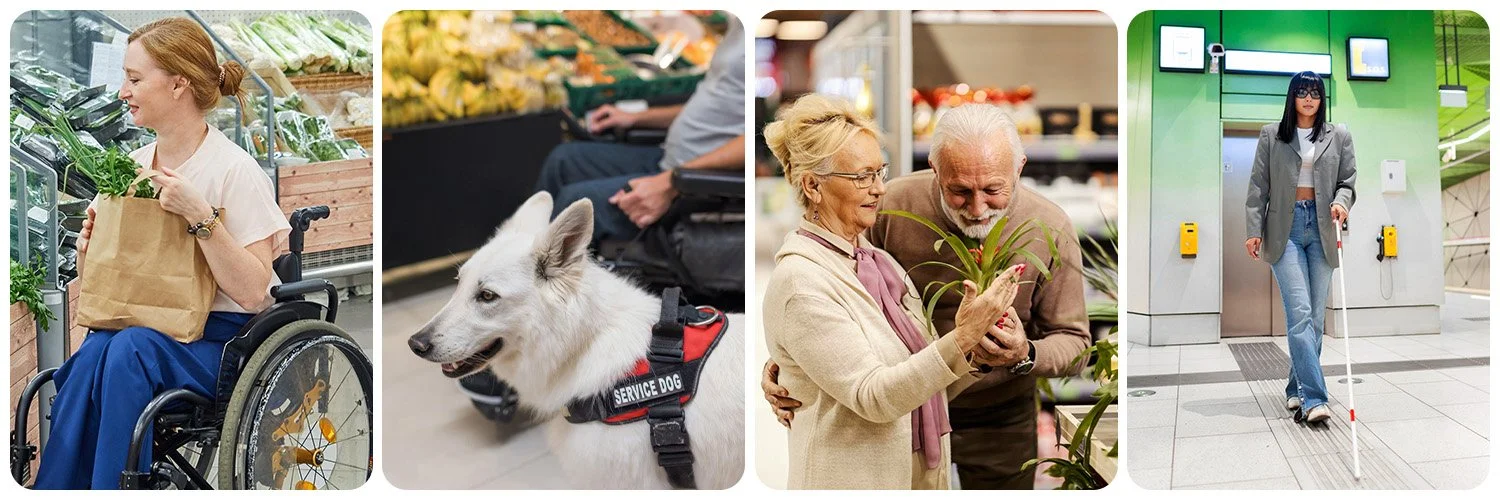
The growth of self-service solutions
The last decade has brought self-service solutions to thousands of stores around the world. Whether it is self-scanning, self-checkout, RFID checkout, or similar retail technology, this type of autonomous shopping has been embraced by both shoppers and retailers.
While some shoppers have been easier to convince than others about the benefits of self-service, there has been a clear shift towards greater independence in the shopping journey. With benefits such as shorter queues, faster shopping journeys, and greater freedom, retailers and customers alike have grown accustomed to this new way of shopping.
And there is no end in sight for this shift. More retailers are implementing self-service solutions in their stores, with many offering several types of solutions simultaneously in an effort to improve efficiency while still catering to different customer needs.
But as self-service solutions increasingly replace one or more interactions in the traditional shopping journey, they also need to work for a wide range of shoppers – not just those who are tech-savvy or have no disabilities.
To truly offer greater independence and convenience, self-service must be designed with both usability and accessibility in mind. Following are some of the most prominent factors for retailers to consider when implementing an accessible retail self-service solution.
Self-service accessibility for people with disabilities
There are various disabilities and accessibility needs that should be taken into consideration when designing and implementing a self-service solution. Some of the most common areas to consider are:
Visual impairments: Having reduced or limited vision can make it difficult to operate a self-service device, whether it is a self-scanning unit or a self-checkout machine. Tactile feedback, adjustable text sizes, high contrast, and audio guidance are some of the features that can make self-service solutions more accessible to shoppers with visual impairments.
A study of the importance of providing accessible retail technology:
A recent study conducted in the U.S looked at how accessible self-checkout machines are for blind and low-vision (BLV) shoppers. The researchers surveyed 86 BLV shoppers and also observed 10 BLV participants actually using self-checkouts. They found that many self-checkouts are difficult to use without assistance, reducing users’ independence and sense of equality.
Hearing impairments: Many self-service solutions use sound cues to confirm that an item has been scanned or to signal that something has gone wrong. While sound can be an effective way to communicate that an action has been completed, shoppers who are deaf or have hearing impairments need visual cues as well. Instructions, notifications, and alerts should therefore never be communicated through sound alone.
Motor impairments: Difficulties with reaching, bending, pressing small buttons, or performing other physical movements can negatively affect the self-service experience. By creating an accessible setup that accommodates people with different motor impairments, retailers can reduce the risk of disrupted shopping journeys and provide a more inclusive experience.
Cognitive disabilities: Not all disabilities are visible, and a wide range of cognitive disabilities can make an overly complicated self-service experience frustrating or difficult to navigate. Complicated instructions, information overload, and unclear workflows are some of the barriers retailers should aim to avoid. A simple and intuitive interface can make self-service easier to use for everyone.
There are many types of disabilities and impairments to consider, but accessibility goes beyond these specific needs. Retailers also need to account for the wide range of technological experience and confidence among shoppers. Not everyone is equally familiar or comfortable with self-service technology, and older generations in particular may find adapting to new retail technology more challenging.
Older customers and digital confidence
Customer behaviour and purchasing patterns can vary between generations. Some shoppers have grown up surrounded by digital technology, while others have had to adapt to an increasingly digital world over time. This does not mean that everyone within a particular generation has the same level of technological confidence, nor that older shoppers necessarily struggle with self-service technology. However, differences in digital experience and familiarity can create a higher threshold for some customers when encountering new self-service solutions.
Digital familiarity can be described as the level of comfort and ease people feel when using everyday technology such as smartphones, apps, and websites. For shoppers with less experience using digital technology, encountering a new system such as self-scanning or self-checkout can therefore feel challenging. Even seemingly simple steps, such as navigating a touchscreen, scanning a barcode, searching for an item, or responding to an error message – may be less intuitive to someone using the technology for the first time.
Confidence also plays an important role. If shoppers do not feel confident enough to try a self-service option, they may continue choosing a traditional checkout instead. As a result, they never get the opportunity to become familiar with the technology and potentially make it part of their regular shopping routine.
For retailers, the challenge is therefore not only to provide self-service technology, but to make the first interaction with it as simple and welcoming as possible. Clear instructions, intuitive workflows, easily accessible assistance, and staff members who can guide customers through their first attempts can help lower the barrier to adoption. A well-designed self-service solution should not require customers to be technologically experienced – it should be intuitive enough to guide them along the way.
One solution, many different shoppers
There is no single type of shopper – and therefore no single set of needs that a self-service solution must meet. Customers differ in age, abilities, digital experience, preferences, and expectations. While one shopper may embrace a new self-scanning solution immediately, another may need additional guidance or an alternative way to complete the same task.
For retailers, this makes flexibility an important part of choosing the right self-service technology. A solution should not only work well for the confident and experienced user; it should be designed to accommodate different abilities and levels of digital familiarity. Accessible interfaces, intuitive workflows, clear feedback, and the possibility to adapt the experience to different needs can all contribute to making self-service more inclusive.
It is also important to remember that accessibility and usability are not simply about removing barriers for specific groups. Features that make a solution easier to understand, navigate, and operate can improve the shopping experience for everyone. The easier it is for customers to use self-service independently and confidently, the greater the opportunity for both shoppers and retailers to benefit from the technology.
As self-service continues to become a bigger part of the retail experience, retailers should therefore look beyond functionality alone. Choosing a solution that is built with flexibility, accessibility, and different shoppers in mind creates a stronger foundation – not only for the customers using it today, but also for the changing needs of tomorrow.